
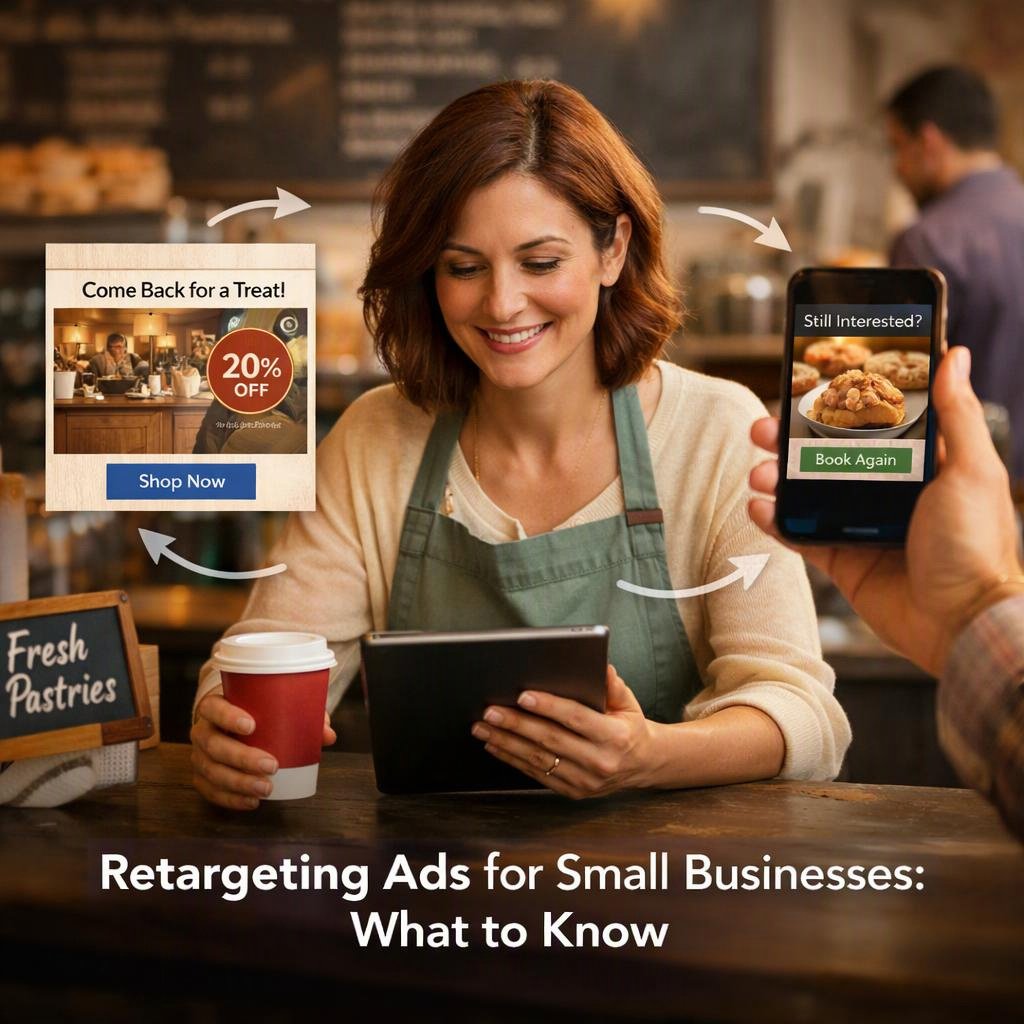
Most people who visit your website leave without buying anything. That’s not a pessimistic take — it’s just how online behavior works. Studies consistently show that the vast majority of first-time website visitors aren’t ready to purchase, and without a follow-up strategy, those potential customers simply disappear. Retargeting ads exist to solve exactly that problem.
For small businesses working with tight ad budgets, retargeting ads offer something genuinely valuable: the ability to re-engage people who already showed interest. Instead of spending every dollar chasing cold audiences who’ve never heard of you, retargeting lets you focus on warm prospects who visited your site, browsed your products, or started a checkout process. That’s a smarter use of limited resources. If you’re exploring what actually works in digital marketing for small businesses, retargeting consistently ranks among the highest-ROI tactics available.
This guide covers everything a small business owner needs to know about retargeting ads — from how they work and when to use them, to setting up campaigns, managing budgets, and measuring results. No fluff, no jargon overload. Just practical information you can act on.
Retargeting Ads Explained for Small Businesses
Retargeting ads are paid advertisements shown specifically to people who have previously interacted with your business online. That interaction might be visiting your website, watching a video, engaging with a social media post, or clicking an email link. The ads follow those users across other websites and platforms, reminding them of what they viewed and encouraging them to return.
The technology behind retargeting relies on pixel tracking — a small piece of code placed on your website that drops a cookie in a visitor’s browser. That cookie signals ad platforms like Google Ads or Facebook Ads to serve your ads to that specific person as they browse elsewhere online.
| Retargeting Type | Trigger | Best Platform | Typical Use |
|---|---|---|---|
| Site-based | Website visit | Google, Meta | Re-engage browsers |
| Engagement-based | Social interaction | Meta, TikTok | Warm social audiences |
| Email-based | Email list upload | Meta, Google | Cross-channel follow-up |
| Search-based | Search behavior | Google Ads | High-intent remarketing |
How Retargeting Differs from Prospecting
Prospecting targets people who have never interacted with your brand. You’re introducing yourself to a cold audience using demographic, interest, or keyword-based targeting. Retargeting, by contrast, targets people who already know you exist. That distinction matters enormously for conversion rate and cost efficiency.
Prospecting builds brand awareness and fills the top of your marketing funnel. Retargeting works the middle and bottom — nudging people who are already considering your offer. Both are necessary, but they serve different purposes and require different creative approaches.
When Retargeting Makes Sense for Limited Budgets
Small businesses with modest ad budgets should prioritize retargeting when they already have consistent website traffic. If fewer than a few hundred people visit your site monthly, your retargeting audience will be too small to generate meaningful results. Traffic volume matters.
Retargeting also makes sense when your sales cycle is longer than a single visit. Service businesses, higher-ticket products, and anything requiring comparison shopping all benefit from staying visible during the decision-making period. The goal is to remain top of mind without being intrusive.
Benefits, Limitations, and Common Misconceptions
The benefits of retargeting ads for small businesses include higher conversion rates compared to cold traffic campaigns, lower cost per acquisition over time, and stronger return on investment from existing traffic. You’re not paying to attract new visitors — you’re maximizing the value of people already interested.
Limitations exist too. Retargeting requires a baseline of traffic to work. It doesn’t fix a broken offer or a poor landing page. And it can feel creepy to users if done poorly, which damages brand perception rather than building it.
Common misconceptions include the belief that retargeting alone can replace prospecting, or that it works instantly with tiny budgets. It’s a support strategy, not a standalone solution.
Planning Audiences, Offers, and Campaign Goals
Before launching any retargeting campaign, you need a clear plan. Jumping straight to ad creation without defining your audiences and goals is one of the most common mistakes small businesses make. Strategy first, execution second.
Segmenting Visitors by Intent and Recency
Not all website visitors are equal. Someone who spent four minutes reading your service page and visited your contact form is far more valuable to retarget than someone who bounced after two seconds. Audience segmentation lets you treat these groups differently.
Segment by pages visited, time on site, and recency. A visitor from the past seven days is much warmer than someone who visited sixty days ago. Create separate audience segments for high-intent visitors, general browsers, and people who started but didn’t complete a conversion action.
Excluding Customers, Converters, and Irrelevant Users
Exclusions are just as important as inclusions. Showing retargeting ads to people who already purchased wastes your ad budget and annoys customers. Always exclude recent converters from your standard retargeting campaigns.
- Exclude users who completed a purchase or form submission
- Exclude existing email subscribers already in a nurture sequence
- Exclude visitors who spent less than five seconds on your site
- Exclude audiences that have already seen your ad many times without converting
Custom audiences built from your customer list help ensure you’re not wasting spend on people who don’t need to be retargeted.
Choosing Offers and Messages for Each Buying-Stage Audience
A visitor who viewed your pricing page needs a different message than someone who only read your blog. Match your offer to where each audience sits in the marketing funnel. High-intent visitors respond well to direct offers, limited-time discounts, or strong calls to action. Earlier-stage visitors may need more education or social proof first.
Tailoring your creative to audience intent dramatically improves click-through rate and conversion rate. Generic ads shown to all retargeting audiences underperform consistently. Specificity wins.
Setting Up and Managing Retargeting Campaigns
Setup quality determines campaign performance. Poorly installed tracking, vague conversion events, and mismatched landing pages all undermine results before a single dollar is spent. Getting the technical foundation right is non-negotiable.
Installing Tracking Tags and Defining Conversion Events
Every major ad platform requires a tracking tag installed on your website. Google Ads uses the Google tag. Meta uses the Meta Pixel. These tags collect data about visitor behavior and power your retargeting audiences. Install them correctly and verify they’re firing on the right pages.
Define conversion events clearly. A conversion might be a form submission, a phone call, a purchase, or a specific page visit. Without defined conversion events, you can’t measure what’s working or optimize your campaigns effectively. Use Google Tag Manager to manage multiple tags without cluttering your site’s code.
Using Google, Meta, and Other Suitable Advertising Platforms
Google Ads offers display ads and search-based remarketing across millions of websites in the Google Display Network. It’s excellent for reaching people while they browse other sites or search for related terms. Pay-per-click retargeting through Google keeps costs tied directly to engagement.
Facebook Ads and Instagram, both managed through Meta’s ad platform, offer powerful social media advertising with detailed custom audiences and engagement-based retargeting. For many small businesses, Meta delivers strong results at accessible entry-level budgets.
Other platforms worth considering include LinkedIn for B2B businesses, Pinterest for product-based brands, and TikTok for younger demographics. Choose platforms where your target audience actually spends time, not just the most popular options.
Creating Landing Pages, Ad Variations, and Frequency Controls
Your retargeting ad is only as good as the landing page it leads to. Send retargeted visitors to pages that match the ad’s message exactly. If your ad promotes a specific service, the landing page should focus entirely on that service — not your homepage. Mismatched experiences kill conversion rates.
Create multiple ad variations to avoid showing the same creative repeatedly. Ad frequency is a critical metric to monitor. Showing the same ad to the same person more than three to five times per week typically causes ad fatigue and negative brand sentiment. Rotate creative regularly and set frequency caps within your campaign settings.
Handling Consent, Privacy, and First-Party Data Responsibly
Privacy regulations affect how retargeting works. Cookies face increasing restrictions, and users in many regions must actively consent to tracking. Your website needs a compliant cookie consent mechanism that gives visitors genuine choice.
First-party data — information collected directly from your customers through email sign-ups, purchases, and account creation — is becoming more valuable as third-party cookies decline. Building your email marketing list and using it to create custom audiences on ad platforms is a smart long-term strategy. For small businesses exploring affordable marketing strategies, first-party data collection costs very little and pays dividends across multiple channels.
Measuring Performance and Improving Results
Running retargeting campaigns without measuring performance is like driving without a dashboard. You need clear metrics to know whether your ad budget is generating returns or simply disappearing. Measurement isn’t optional — it’s the entire feedback loop.
Tracking Reach, Frequency, Click-Through Rate, and Conversions
Start with the basics. Reach tells you how many unique people saw your ads. Frequency shows how many times each person saw them on average. Click-through rate measures how compelling your ads are. Conversions tell you whether those clicks resulted in meaningful actions.
Monitor these metrics weekly, not monthly. Retargeting campaigns can deteriorate quickly if frequency climbs too high or if a small audience becomes oversaturated. Early detection prevents wasted spend.
Evaluating Cost per Acquisition and Return on Ad Spend
Cost per acquisition tells you what you’re paying for each customer or lead generated through retargeting. Return on ad spend measures revenue generated for every dollar spent. Both metrics help you determine whether your campaigns are profitable.
Small businesses should set clear targets before launching. Know what a customer is worth to your business and what you can afford to pay to acquire one. If your cost per acquisition exceeds customer lifetime value, the campaign needs adjustment regardless of how impressive other metrics look.
Testing Creative, Audience Windows, Budget, and Offers
Improvement comes through systematic testing. Change one variable at a time so you can identify what actually caused a performance shift. Test different ad creative, different audience window lengths, different offers, and different budget allocations.
- Test audience windows of seven, fourteen, and thirty days
- Compare image ads against video ads for the same audience
- Test discount offers against value-focused messaging
- Compare direct response calls to action against softer engagement prompts
Document every test and its outcome. Over time, this builds a clear picture of what resonates with your specific audience.
Recognizing Ad Fatigue, Attribution Limits, and Wasted Spend
Ad fatigue happens when your audience sees your ads too often. Signs include declining click-through rate, rising cost per click, and negative comments on social ads. Refresh creative every few weeks and rotate messaging to keep campaigns feeling fresh.
Attribution is imperfect. Last-click attribution gives all credit to the final ad a person clicked before converting, ignoring earlier touchpoints. Multi-touch attribution models give a more accurate picture but require more sophisticated tracking. Understand the limits of whatever attribution model your platform uses before drawing firm conclusions about performance.
Conclusion
Retargeting ads give small businesses a practical way to recover lost opportunities and convert warm prospects who already showed interest. The strategy works best when built on solid tracking, thoughtful audience segmentation, and consistent creative testing. It’s not a magic solution, but it’s one of the most cost-efficient tools available in digital marketing when implemented correctly.
Start small, measure everything, and refine based on real data. A well-managed retargeting campaign with a modest ad budget will consistently outperform a larger prospecting campaign aimed at cold audiences. The people who already visited your site are your best opportunity — retargeting makes sure you don’t leave that opportunity on the table.
FAQ
How much should a small business spend on retargeting ads?
Most small businesses can start with a modest daily budget and still see meaningful results, provided their website traffic is sufficient to build a usable audience. The key is ensuring your audience size is large enough to generate data. Platforms like Google Ads and Meta both allow low minimum daily spends, making retargeting accessible even for businesses with tight ad budgets. Scale spending as you identify what’s working.
How long should a retargeting audience remain active?
Audience window length depends on your sales cycle. For impulse purchases, a seven-day window often works well. For higher-consideration purchases or service businesses, thirty to ninety days is more appropriate. Test different windows and compare conversion rates. Longer windows increase audience size but reduce average intent level, so balance reach against relevance carefully.
Are retargeting ads effective without third-party cookies?
Yes, though the approach shifts. First-party data collected directly from your customers — through email sign-ups, purchases, and CRM records — can be uploaded to ad platforms to create custom audiences that don’t rely on third-party cookies. Contextual targeting, which places ads based on page content rather than user tracking, is also gaining traction. Small businesses that invest in building their own customer data now will be better positioned as cookie-based tracking continues to decline. Exploring a zero-click marketing strategy alongside retargeting can further strengthen your ability to reach audiences through multiple channels simultaneously.