
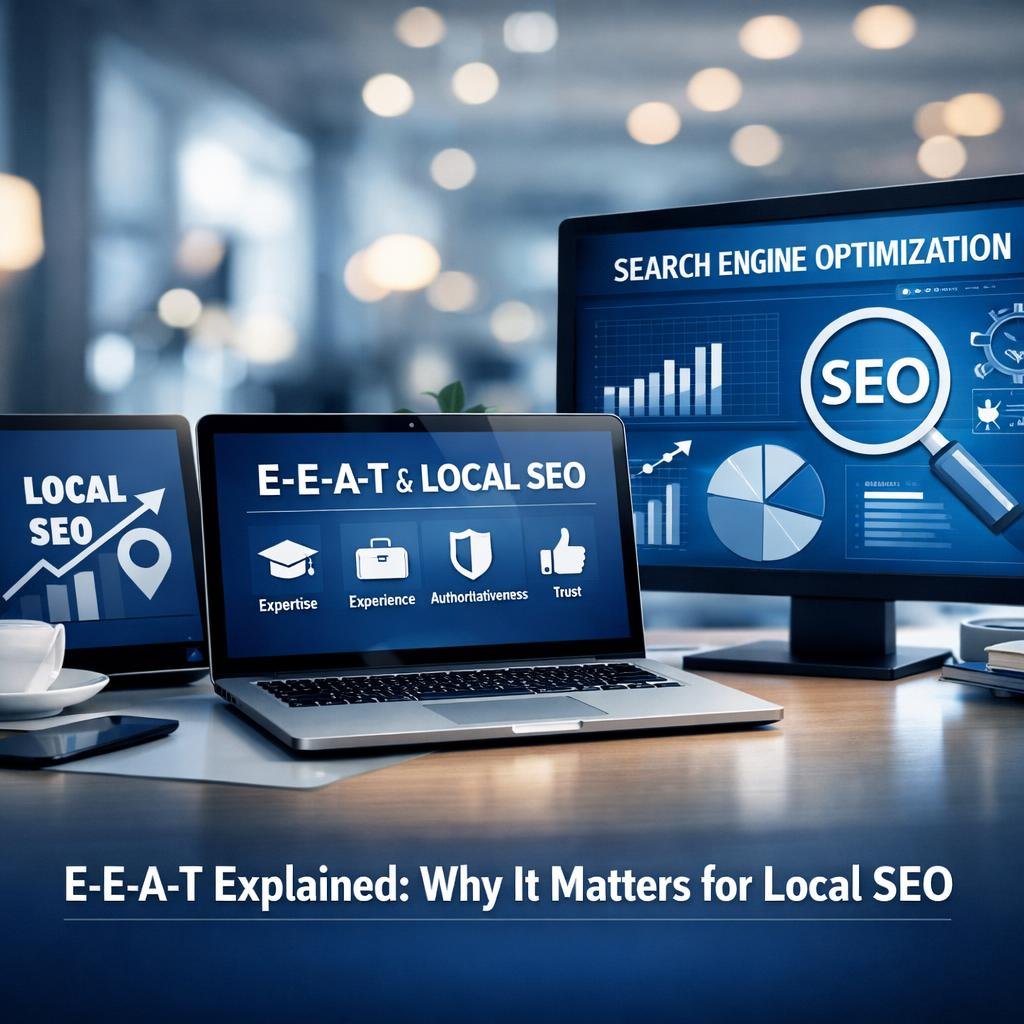
Local search is competitive. When someone searches for a plumber, dentist, or restaurant near them, Google doesn’t just look at keywords — it evaluates whether your business deserves to be trusted. That evaluation process is shaped significantly by a framework called E-E-A-T, which stands for Experience, Expertise, Authoritativeness, and Trustworthiness. Understanding this framework is one of the most practical steps any local business owner can take to improve their visibility in search results.
Most local businesses focus on the basics: a Google Business Profile, a few citations, maybe some reviews. Those things matter, but they’re only part of the picture. Google’s Search Quality Rater Guidelines make it clear that content and business credibility are evaluated through a quality lens that goes much deeper than technical SEO. If your website and online presence don’t signal genuine trust and real-world expertise, you’re leaving rankings on the table.
This guide breaks down E-E-A-T in plain language, explains why it directly affects local search rankings, and gives you a clear path to strengthening your signals — whether you run a solo operation or a multi-location business.
What readers will learn about E-E-A-T and local SEO
You’ll walk away understanding exactly what E-E-A-T means, how Google applies it to local businesses, and what specific actions you can take to improve your standing. This isn’t theory — it’s practical guidance built around how local search actually works.
Why trust and credibility are critical for local search visibility
Google’s goal is to connect searchers with businesses they can rely on. Trustworthiness is the foundation of the entire E-E-A-T framework, and for local businesses, it’s expressed through reviews, accurate information, professional content, and consistent online presence. Without these signals, even well-optimized pages can underperform.
Understanding E-E-A-T in Simple Terms
What E-E-A-T means: Experience, Expertise, Authoritativeness, Trust
E-E-A-T is a quality evaluation framework drawn from Google’s Search Quality Rater Guidelines. Human quality raters use it to assess whether content and businesses meet a high standard of credibility. Here’s what each element means in practice:
| Element | What It Means | Local Example |
|---|---|---|
| Experience | First-hand knowledge of a topic or service | A plumber sharing real job photos and case studies |
| Expertise | Demonstrated skill and knowledge in a field | A clinic listing doctor credentials and specializations |
| Authoritativeness | Recognition from others in your industry or community | A restaurant featured in local press or food blogs |
| Trustworthiness | Accuracy, transparency, and reliability | Consistent NAP details, secure website, clear policies |
How Google uses E-E-A-T as a quality lens for content
Google doesn’t use E-E-A-T as a direct algorithmic ranking signal in the traditional sense. Instead, it informs how quality raters evaluate pages, and those evaluations help train and refine the search algorithm over time. Content that scores well on E-E-A-T tends to align with what Google’s algorithm rewards.
For local businesses, this means your website content, Google Business Profile, and overall online presence all contribute to how Google perceives your credibility. It’s a holistic evaluation, not a single checkbox.
How E-E-A-T shows up differently for local businesses vs. national brands
National brands build authoritativeness through massive backlink profiles and widespread media coverage. Local businesses build it differently — through community involvement, local citations, customer testimonials, and consistent engagement on platforms like Google Business Profile. The signals are smaller in scale but equally meaningful to local search rankings.
Why E-E-A-T Matters So Much for Local SEO
How E-E-A-T influences local pack rankings and map visibility
The local pack — those three business listings that appear at the top of a local search results page — is prime real estate. Google selects businesses for that pack based on relevance, distance, and prominence. E-E-A-T feeds directly into prominence. A business with strong reviews, authoritative local mentions, and a well-optimized Google Business Profile signals to Google that it deserves a top spot.
If you’re working to improve your local search rankings, understanding how local SEO works for smaller operations is a smart starting point before layering in E-E-A-T improvements.
The role of reviews, ratings, and real-world experience signals
Online reviews are one of the most visible E-E-A-T signals for local businesses. A high volume of detailed, positive reviews tells Google — and potential customers — that real people have had real experiences with your business. Star ratings, review recency, and owner responses all contribute to your trustworthiness score in Google’s eyes.
Beyond reviews, experience signals include photos of actual work, detailed service descriptions, and content that reflects genuine knowledge of your trade or industry.
How E-E-A-T connects with on-page SEO, Google Business Profile, and citations
E-E-A-T doesn’t exist in isolation. It connects with your entire local SEO ecosystem. Your Google Business Profile should reflect accurate, complete information. Your website should include author credentials, service details, and location-specific content. Local citations across directories must maintain NAP consistency — the same name, address, and phone number everywhere. Schema markup on your website helps Google understand your business type, location, and services, reinforcing your credibility signals.
Step-by-Step: Applying E-E-A-T to a Local Business
Optimizing your website to show experience and expertise
Your website is your most controllable E-E-A-T asset. Start with these fundamentals:
- Add an “About” page that highlights your background, certifications, and years of experience
- Include real photos of your team, workspace, and completed projects
- Write service pages that go beyond generic descriptions — explain your process and what makes your approach different
- Use schema markup to identify your business type, location, and service areas
- Feature customer testimonials prominently, with names and specific details where possible
Content quality matters enormously here. Thin, generic pages that could belong to any business in your industry do nothing to demonstrate expertise.
Strengthening authoritativeness with reviews, links, and local mentions
Authoritativeness is built externally — it’s what others say about you. Focus on local link building by reaching out to community organizations, local news outlets, and industry associations. Getting mentioned or featured on reputable local websites sends strong authority signals.
Encourage satisfied customers to leave detailed reviews on Google. Respond to every review, positive or negative. Pursue backlinks from local business directories, chamber of commerce listings, and relevant industry sites. Page authority and domain authority both grow over time as these signals accumulate.
Building trust with clear contact details, policies, and secure technology
Trust signals are often the most overlooked part of E-E-A-T for local businesses. A website without HTTPS, a missing privacy policy, or inconsistent contact information can quietly undermine your credibility.
Make sure your site includes:
- A clearly visible phone number and physical address on every page
- An SSL certificate (HTTPS) for a secure browsing experience
- A privacy policy and terms of service page
- A refund or service guarantee policy where applicable
- Consistent NAP details that match your Google Business Profile and all local citations
Practical examples for common local businesses (plumber, restaurant, clinic)
A plumber can demonstrate E-E-A-T by publishing before-and-after project photos, listing trade certifications, and collecting reviews that mention specific jobs. A restaurant builds trust through health inspection scores, chef bios, and consistent responses to diner feedback. A medical clinic needs to go further — listing doctor credentials, linking to professional associations, and ensuring all health-related content is reviewed by qualified practitioners.
Each business type has unique E-E-A-T opportunities. The key is making your real-world expertise visible online in ways that both Google and potential customers can recognize.
Simple maintenance routine to keep E-E-A-T signals strong over time
E-E-A-T isn’t a one-time fix. Build a monthly routine that includes checking your Google Business Profile for accuracy, responding to new reviews, auditing your citations for consistency, and refreshing at least one piece of website content. This ongoing effort compounds over time and keeps your signals current and credible.
Common Problems and E-E-A-T Troubleshooting
Recognizing weak E-E-A-T signals that hold local rankings back
Weak E-E-A-T often looks like this: a sparse website with no team information, few or no reviews, inconsistent business listings across directories, and content that reads like it was written for any generic business rather than yours specifically. These gaps tell Google there isn’t enough evidence to trust your business with prominent placement in local search results.
Fixing thin or generic content that fails to show real expertise
Generic content is one of the most common local SEO problems. A service page that simply lists what you do without explaining how, why, or who does it fails the expertise test. Rewrite thin pages with specific details: mention your team’s qualifications, describe your process step by step, and address the real questions your customers ask. For businesses looking to grow their online presence affordably, exploring cost-effective marketing strategies for small businesses can help prioritize where to invest your content efforts first.
Handling negative reviews and reputation issues the right way
Negative reviews happen to every business. How you respond matters more than the review itself. Reply professionally, acknowledge the concern, and offer a resolution. Never argue or dismiss complaints publicly. A thoughtful response to a negative review can actually strengthen your trustworthiness signals by showing that your business takes customer experience seriously.
If you’re dealing with a pattern of negative feedback, treat it as operational feedback first and an SEO issue second. Fix the underlying problem, then work on rebuilding your review profile through genuine customer outreach.
Diagnosing traffic drops that may be related to E-E-A-T issues
If your local search traffic has dropped without an obvious technical cause, E-E-A-T degradation may be a factor. Check whether your content has become outdated, whether new competitors have stronger review profiles, or whether your citations have developed inconsistencies. Improving your content quality and refreshing your Google Business Profile are good first steps. For a broader approach to recovering visibility, reviewing tactics to drive more traffic to your website can help identify additional gaps in your strategy.
Conclusion
Key takeaways: how E-E-A-T supports long-term local SEO success
E-E-A-T is not a shortcut — it’s a long-term investment in your business’s credibility. Businesses that consistently demonstrate real experience, genuine expertise, recognized authoritativeness, and clear trustworthiness build a foundation that holds up through algorithm changes and competitive shifts. Local search rewards businesses that earn trust, not just those that optimize technically.
Quick action checklist for improving E-E-A-T this month
- Audit your Google Business Profile for completeness and accuracy
- Check NAP consistency across your top ten local citations
- Add or update your About page with real credentials and team information
- Request reviews from five recent satisfied customers
- Respond to all unanswered reviews on Google
- Add schema markup to your homepage and key service pages
- Rewrite your weakest service page with specific, expert-level detail
- Verify your site uses HTTPS and displays clear contact information
FAQ
Is E-E-A-T an official ranking factor for local SEO?
Google has stated that E-E-A-T is not a direct ranking factor in the algorithmic sense. However, it shapes how quality raters evaluate content and businesses, which in turn influences how the search algorithm is refined. Practically speaking, strong E-E-A-T signals correlate consistently with better local search rankings.
How long does it take for stronger E-E-A-T signals to impact local rankings?
There’s no fixed timeline. Some improvements — like updating your Google Business Profile or fixing citation inconsistencies — can show results within weeks. Building authoritativeness through reviews and local link building is a slower process that typically unfolds over several months. Consistency matters more than speed.
Do very small or solo local businesses really need to worry about E-E-A-T?
Absolutely. Solo operators and micro-businesses often compete directly with larger companies in local search. A solo plumber with a well-optimized website, strong reviews, and clear credentials can outrank a larger company with weak E-E-A-T signals. Size doesn’t determine credibility — your online presence does.